Showing posts with label Proteins. Show all posts

Applications of Enzymes

As mentioned earlier most enzymes are proteins and carry out different metabolic functions in the body. They have numerous applications. Some important ones are given below:

Role in Medicines


One of the important applications of enzymes is in disease diagnosis. Alterations in the blood levels of certain enzymes occur during diseased conditions and are listed in Table. Measuring the levels of these enzymes would tell us the health status of a person.
Enzymes of clinical importance
Enzymes also have applications in medical therapy. Streptokinase is an enzyme, which breaks down fibrinogen as well as plasminogen. Plasmin formed fiom the latter helps in dissolving clot. This enzyme is now used to dissolve blood clots in the body to prevent heart ailments.

Industrial Applications


In meat industry, enzymes are used for tenderization, a process that makes muscle tissue soft. Some of these enzymes are fiom plant sources: papain (papaya), ficin (fig), bromelein (pineapple). Bacterial and fungal enzymes are: hydrolase D, protease 15 and rhozyme. Details of tenderization are given else where in this course. In milk industry, rennet, an enzyme obtained from calf intestinal linings, is used for cheese preparation.

Protein Deficiency Diseases

You all studied earlier that protein constitutes the major portion of our body mass after water. There are a number of diseases related to protein metabolism and its deficiency in diet. For better understanding its better to deal deficiency diseases in correlation to functional importance of protein. The subject has been dealt here under different headings.

Protein Turnover


Tissue proteins are continuously being broken down into amino acids and are then rebuild into tissue proteins. This process is called protein turnover and varies in different tissues. High protein turnover is observed in the intestine (epithelium), liver, pancreas and kidney whereas; muscle, brain and skin have low. Structural tissues such as collagen and bone have very low turnover. Dietary deficiency of protein may lead to structural and functional alteration of these important body parts.

Protein Balance


Body proteins exist in two compartments: Tissue proteins and plasma proteins. Balance between the two compartments is maintained by dietary protein intake. There is a give and take relationship between the two compartments at times. During growth, the protein synthesis is higher so that the new tissues could be formed whereas during ageing, tissue breakdown exceeds that of synthesis and the body gradually deteriorates.

Criteria to assess a person's state of protein balance are the measurement of total nitrogen. Total body nitrogen includes, protein nitrogen and non-protein nitrogen represented by compounds such as urea, ammonia, uric acid etc. It is an indication of all nitrogen gains and losses in the body protein. A net negative nitrogen balance is not a healthy sign and reflects increased loss of body protein and low input of food protein. It is observed during long illness, starvation or hyper metabolism (higher body activity).

Protein Requirements


The primary purpose of protein in the diet is to supply amino acids in sufficient quantity for growth and tissue maintenance. There is an enhanced protein requirement during growth. Also important is the nature of protein in the diet and its amino acid composition. Sufficient non-protein foods in the diet are also essential so that proteins are not used up for energy production. This is called protein-sparing effect. The digestibility and absorbability of the protein is affected by cooking methods and other factors. The recommended amount of protein per day (RDA) amounts to about 60-65 gramsfday for a healthy man and 50 grams 1 day for a woman, which increases during pregnancy and lactation. The nutritive value of a food protein is often expressed in terms of its chemical score, a value reflecting its amino acid composition. The chemical score of aprotein is calculated by comparing its amino acid composition with that of egg protein, taken as a standard, having a value of 100. Other criteria that are also considered during the calculation of chemical score of a protein are:

  • Biological value (BV) based on nitrogen balance.
  • Net protein utilization (NPU) based on biological value and degree of digestibility
  • Protein efficiency ratio (PER) based on weight gain of a growing test animal divided by its protein intake.

As we discussed in the protein function that it plays a vital role in the regulation of body process. Deficiency may lead to hormonal imbalance, poor immune status, anemia, wasting condition as well as impairment of several body processes because of lack of necessary enzymes.

Protein Calorie Malnutrition (PCM) 


Growing children require a higher amount of protein and energy (Kcal) per kilogram of body weight than adults. Breast milk usually provides these needs during infancy (first six months). After that, weaning foods adequate in calories, protein, vitamins and minerals need to be added to the breast milk diet for growth.

Protein calorie malnutrition (PCM), a nutritional deficiency, is prevalent among infants and small children particularly in underdeveloped poor countries. PCM is characterized by poor growth and is manifested in two forms: Marasmus, a chronic state with severe wasting of the body tissues and Kwashiorkor, in which edema occurs.

Marasmus is seen in young children (three months to three years) and kwashiorkor occurs in the age group of one to five years. Marasmus is due to low calorie low protein diet whereas kwashiorkor develops due to protein deficiency even though there are sufficient kilocalories in the diet.

Meat Proteins - Structure and Classification

Meat in true sense refers to the flesh of animals used as food. It includes muscles (musculature), organs such as liver, kidney, brains and other edible tissues. The term carcass is used in meat industry and represent the portion of body left after removal of the blood, head, feet, hides, internal organs (digestive tract, intestine, bladder, heart, trachea, lungs, kidneys, spleen etc.) and adhering fatty tissues.

Chemical and Biochemical Constituents of Muscle


The approximate composition of meat is: 75 per cent water, 19 per cent protein, 3.5 per cent of soluble non-protein substances and 2.5 per cent fat. It must be remembered that meat is the resultant product of a complicated postmortem changes of a tissue.
Chemical composition of a typical adult mammalian muscle
Muscle proteins can be broadly classified into three types depending on their solubility properties:

i) Sarcoplasmic proteins: These are readily extracted in aqueous solution of low ionic (0.15 or less) strength i.e., soluble in water or very dilute salt solutions. It constitutes about 5.5 per cent of total muscle mass. There are about 50 sarcoplasmic proteins. It includes myoglobin, hemoglobin, enzymes associated with glycolysis, the tricarboxylic acid cycle and the electron transport chain, flavour proteins.

ii) Myofibrillar proteins: These are soluble in concentrated salt solutions and require higher (0.3 or greater) ionic strength solutions of sodium or potassium salts for their extraction. Since they are extracted by salt solutions, they are called salt-soluble proteins. They constitute about 11.5 per cent of muscle mass. The myofibrillar proteins are hrther classified into three categories.

a) Contractile Proteins: Actin and myosin constitute the major contractile proteins. They are named so because of their role in muscle cot traction. Actin constitutes approximately 20 per cent of the myofibrillar proteins whereas myosin, fibrous in nature constitutes 45 per cent of the myofibrillar protein. Actin forms the thin filament whereas myosin forms thick filament. The monomeric unit for actin is globular actin or G action and it links to form fibrous actin or F actin. In F action, the G action monomers are linked together in strands, much like beads on a string of pearls. Super helix, a characteristic of actin filament is formed as result of spiral coiling of two strands of F actin around each other. As far as myosin is concerned, proteolytic enzyme degradation reflects two fractions - light meromyosin and heavy meromyosin. The structure 01 the myosin molecule is an elongated rod shape with a thickened portion at one end called head, thin backbone called tail and a connecting between two is neck. Myosin has six subunits (polypeptides): two heavy chains and four light chains. The heavy chains are extended and wrapped around each other in a coiled manner. Molecules of myosin aggregate in muscles to form thick filaments which act as the basic contractile unit.

b) Regulatory proteins: These are involved in regulation of actin-myosin interaction during muscle contraction and in maintenance of myofibril integrity. The chief regulatory proteins are tropomyosin, troponin. a-actinin and p-actinin. Tropomyosin is approximately five per cent ol myofibrillar protein and lies in close contact with actin filament Tropomysoin exerts inhibition on crossbridge formation between actir and myosin except during contraction. Troponin is another regulator protein, approximately five per cent of myofibrillar protein and also founc in close association to actin. It is responsible for picking up the Ca2- available in sarcoplasm because of action potential. The calcium bind to troponin and this calcium activated troponin relieve inhibition being exerted by tropomyosin to facilitate contraction. The other two protein a and p-actinin constitute approximately two per cent and one per cen respectively and found in Z disc and free end of thin filaments within r band.

c) Cytoskeleton protein: They serve as the template and / or provide th scaffold for the alignment of myofilaments during myofibril an sarcomere formation. In mature muscle, these are responsible for maintenance of overall longitudinal and lateral alignment as well as structural integrity of myofibrils. Cytoskeleton proteins includes titin, nebulin, C-protein, myomesin, M-protein, desmine, filamin, vinculin, synemin, 2-protein, creatinine kinase.

iii) Stromal protein: They are of fibrous nature and not soluble even in high ionic strength salt solutions. These are refered as insoluble protein fraction of muscle. As such in muscle fiber they are approximately two per cent but more in connective tissue. The major stromal proteins are collagen, elastin and reticulin. Collagen is the most abundant protein in  animal body, about 20-25 per cent of total body protein. The tropocollagen is the structural unit of collagen fibril. Collagen is a glycoprotein which is a most abundant amino acid and one third of collagen is glycine. The relative insolubility and high tensile strength of collagen fibers results from intermolecular cross-linkages which influence meat tenderness.

Elastin is rubbery protein present throughout the body in ligament and arterial walls. It comprises of high content (about 90 per cent) of nonpolar amino acids responsible for its extreme insolubility. Being resistant to digestive enzyme and cooking, it contributes little or nothing to nutritive value of meat. Reticulin is another stromal protein which gives black with ammonical silver. It is different from collagen in having intimate association with lipids containing myristic acid.

Proteins - Building Blocks, Types and Sources

Each protein is a collection of several amino acids and these amino acids are called building block of proteins. Depending upon these buildigg blocks, nature of the protein'varies. Building blocks, types and sources of different proteins are described below:

Building Blocks of Protein - Amino acids


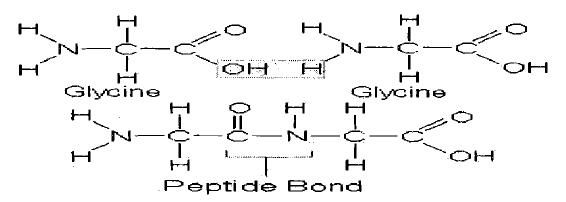
There are 22 amino acids that usually makeuplform proteins. Amino acids are covalently linked in proteins in a linear fashion by a linkage called peptide bond.
A molecule of water is removed from two glycine amino acids to form a peptide bond
It is remarkable that though different proteins contain the same set of amino acids, they differ in their arrangement in linear chain to give rise to proteins with diverse functions such as enzymes, antibodies, hormones etc. As the name indicates, amino acids contain at least an amino and a carboxyl group. Based on their chemical properties, amino acids can be grouped into five classes: nonpolar, polar, aromatic, basic and acidic. However, on nutritional basis they are classified as essential amino acids and non-essential amino acids. There are eight amino acids that are grouped under essential amino acids. These are required in the diet because body cannot synthesize them. The remaining amino acids can be synthesized in the body and are therefore non-essential in the diet. However, this classification is ambiguous as all the 22 amino acids are necessary for building body's tissue proteins.
Classification of amino acids

Types of Proteins and their Sources


According to the nutritional requirements, proteins are classified as complete or incomplete. This classification is based on the amount of essential amino acids present in a protein. Complete proteins are those that contain all the essential amino acids in sufficient amount and ratio to meet the body's requirements. Proteins of animal origin such as those in egg, meat and milk are considered as complete proteins, whereas proteins derived from plant products such as grains and legumes are incomplete  proteins. Poultry, fish, meat, peanuts, wheat germ, cheese are most concentrated protein foods on weight basis. Milk has 3.0 - 3.5 per cent protein whereas cereals such as rice and oat meal and potatoes have only about 2.0 per cent protein. Vegetables and hits have low protein concentrations.

The nutritive value of plant proteins can be improved by complementation. By combining a plant source low in one amino acid with another supplying that amino acid, we can complement or mutually supplement proteins. Vegetarians should use a combination of complementary protein in their diet. For example, beans, peas are rich in lysine but low in sulphur containing amino acids such as methionine and cysteine which can be complemented by including cereals (wheat) in the diet.

Importance and Functions of Proteins

Proteins are major component of our body cell and play various important roles. Major functions of proteins are detailed out below:

a) Tissue building (growth) and maintenance: This is the main function of dietary proteins. Many proteins are involved in body tissue formation. For example, proteins myosin and actin contribute significantly to muscle structure. Collagen and keratin are other structural proteins.

b) Physiological role: Proteins play a vital role in functionary of body. Enzymes being biocatalyst in nature, are among the most important proteins in the body. They act as catalyst and increase the rate of chemical reactions in the body. Various hormones are of proteinous nature and similar to enzymes regulate metabolic reactions. Besides this, the breakdown product of protein i.e., amino acids, di-peptides, polypeptides are utilized for synthesis of much needed bio-compounds inside body. Tryptophan, an essential amino acid is used to build Niacin (Vitamin B,) and serotonin acts as neurotransmitter. Acid-base balance is important for all physiological activities and is maintained by the buffering action of the proteins. The pH of the blood is slightly alkaline (pH 7.3-7.4). A drastic alteration in blood pH would be fatal. The blood pH is maintained by the buffering actions of proteins, which can accepted release H'essential for pH maintenance. Besides this, blood pigment haemoglobin that helps in transport of gases posses a protein globulin portion. Several lipoproteins are also engaged in transportation work. Protein provides defense to body in the form of antibodies. These proteinous substances are also responsible for gene regulatory, detoxicating and hemostatic function in body. 

c) Energy source: Body does not use proteins as main source of energy. Protein rich foods are expensive. However, proteins can be used for energy requirements ddrhg fasting, long distance running but not in fed state. Protein is also utilized as reserve material for nutrition of developing cells. One gram of protein, releases 4.08 Kcal of energy. It is estimated that close to 58 per cent of dietaty protein may be used up for energy production.

Proteins

The word Protein is derived from greek word proteus, which means to come first. They are the most abundant biological macromolecules / substances present in all types of cells constituting the major components of our muscle mass. Nearly half of the dry weight of a typical animal cell is protein. All proteins contain carbon, hydrogen, oxygen and nitrogen. It also contain sulphur with occasional occurrence of phosphorus. Average composition of protein shows 50% of carbon, 7% of Hydrogen, 23% of Oxygen, 16% of Nitrogen, 0-3% of Sulpher and 0-3% of Phosphorus. Proteins are made up of small building blocks called amino acids. the amino acids chemical compounds that contain both an acidic carboxyl (-COOH) and a basic Amino (-NH2) group.
General structure of an amino acid
Different proteins have different sizes depending on the number of amino acids they contain. They represent molecules through which genetic information is expressed. 'Proteins perform diverse functions and are therefore important part of our diet. Some foods are rich in protein whereas some have low protein content.

Low protein diet results in many disorders that may impair our abilities to perform well. Some specialized proteins called enzymes perform chemical reactions in the body. Enzymes referred as bio catalyst also have industrial applications.